Do facts even matter anymore?
They should while Google is still free.
“One of Ours, All of Yours”
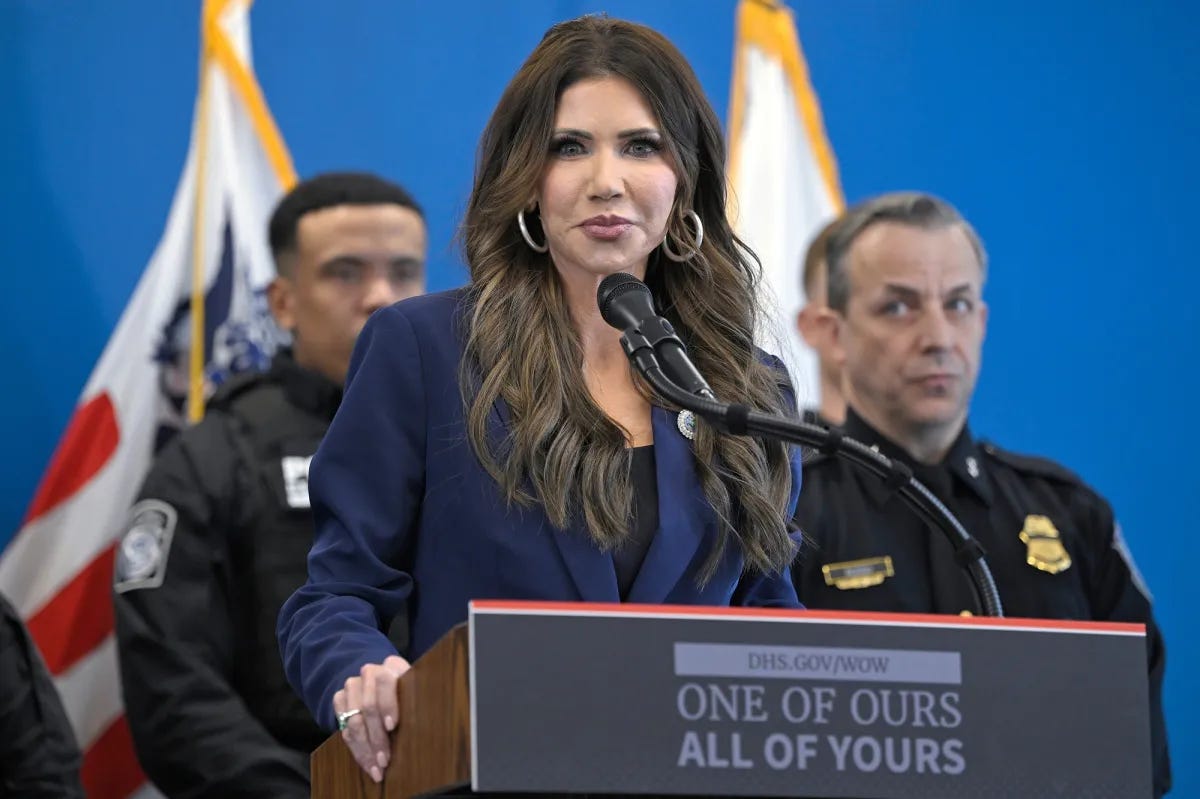
Secretary of Homeland Security Kristi Noem brandished a new slogan earlier this week that got everyone’s attention. The internet immediately picked up the phrase and tied it to the Nazis, including celebrities and elected officials.


The reposts and shares were instant because, Of course she did. Right? I had the exact same reaction.
Except.
There’s actually no historical evidence (that I can find so far) that ties this slogan to the Nazis, or any previous authoritarian regime. I can’t find any record of the slogan existing at all before it showed up on Noem’s podium. Still, some social media creators say it was used by the Nazis to justify their cruel forms of collective punishment, like the Lidice Massacre.
(Trigger Warning: Feel free to skip this paragraph if you need to take care of yourself.
In retribution for the assassination of a Nazi leader, the entire village of Lidice, now in the Czech Republic, was destroyed and 340 people were killed. All men over 15 were shot and all women were sent to the concentration camps while children were “given away” to Aryan families or sent to a death camp, depending on their “racial suitability.”)
But, no one can actually trace the slogan to Lidice, or anywhere else in the decade-long Nazi reign. Well, some internet sleuths did some digging and tied it to another fascist movement in 1930s Spain. Apparently it was a rallying cry (“Uno de los nuestros vale por todos los vuestros”) for the Falange Española… except. There is, again, no evidence (that I can find so far that this is true.)
All of my searches have ended at Reddit. The Nazi connection, I think, has been debunked - even Reddit Historians seem to agree. But some are still claiming that it has just been falsely attributed and should instead be connected to Spain. One Redditor cites his source, kind of, when he mentions that Paul Prescott writes about the slogan in his book Spanish Holocaust. (But again, no actual quotes or helpful citations beyond that. If anyone wants to read the book and let me know if it’s in there that would be great.)
“Emily, why does any of this matter? It’s a terrible slogan and it definitely matches the intentions of the Nazis.”
I agree. It’s a reprehensible call for mass retribution and retaliatory violence that has no place in our (supposed) democracy. That’s what I, Emily the human being, believe. But I’m also a historian.
If there is one thing sacred to historians it’s documentation. Letters, photos, paintings, transcripts of oral histories, previous historical works.
Documents are not the same as facts, but in a field that relies on human memory they are the best tool we have to deciphering the truth as best we can.
I could easily make the argument that Kristi Noem’s new slogan matches the rhetoric of Nazi Germany, because it does. I mean, Hitler literally called for the “annihilation of the Jewish race” as mass retribution for their perceived betrayals to the German nation. One assassinated leader results in 100s of villagers killed. One of ours, all of yours. The connection is clear to a casual audience even if the exact slogan itself was not present at the time.
I really wasn’t sure if I should bring this up on my platform.
I reposted one of these viral photos on my Instagram Stories with a shorter version of this clarification last night and worried that I was doing harm to the anti-Trump/anti-authoritarian movement by picking it apart for something seemingly small.
Within hours I saw a DM that read, “Who cared about the exact words when the sentiment is abundantly clear.” And I, Emily, agree. But I, Emily Glankler (Historian) don’t.
Because facts still matter. I think.
Even though half of our country has lost the ability, or desire, to verify a single thing that comes out of their leaders’ mouths, the other half needs to hold on to that instinct. Not because we’re going to fact check our way out of totalitarianism. But because the record needs to clear. Facts are what put us on the “right side of history” we all keep hearing so much about.
.
.
.
I’ll be honest. Even as I’m writing this I’m not sure I believe it. Technically, I feel confident that I’m right. But facts do feel useless in the face of such an overwhelming wave of bullsh*t.
What does it matter? MAGA supporters aren’t going to listen to us anyway. Anyone still “in the middle” is just tacitly supporting the regime.
But you never know who is listening. You never know which housewife decided to wake up today, see a post about a Nazi slogan and decide, “You know. Maybe my kids are right. I wonder if this is true?” And how tragic that one quick Google search could “prove” Trump’s side right: Any time we do anything they don’t like, the liberals just call us Nazis. That woman retreats into her Moderate Bubble and thinks both sides are terrible and we should all just get along.
You never know which historian is going to be sifting through our artifacts and archives and stumble upon this one Instagram post, and then write an article about how the opposition made up facts, as well. I can see the title now,
True or False Equivalence?
Propaganda, misdirection, and historical lies
in the anti-Trump movement of the mid-21st century
Here’s my point: it’s an easily fact-checkable sloppy mistake. We don’t need to declare that it was a literal Nazi slogan when the slogan is morally reprehensible on its own. We don’t need to “cite” a specific event, like the Lidice Massacre, as proof (and risk discrediting a very real, well-documented atrocity by linking it to internet rumors.)
Facts still matter. We have to hold the line on this. Not because it will get us out of this mess, but to preserve the practice for the next generation. Historians know that knowledge can be lost so quickly. Facts and truths that seem completely obvious, almost innate, to us could disappear from the record by the time my son is an adult. The practice of fact-checking, and questioning, analyzing, etc. is already halfway out the door with younger generations.
The Romans never thought to write down exactly how they made their concrete because it was just a thing that everyone knew. And yet, scientists today are spending years trying to recreate it and find the “magic ingredients” that made it so uniquely strong.
So do your research. It’s really not that hard.
I mean, for me, it took a Google search and two clicks to realize there were no obvious citations for the Nazi slogan theory. People say to me all the time, “I don’t know how you know so much!” or “Where do you get all of the information for your posts?!”
Y’all. I didn’t race down to my secret archives and consult the ancient Historians’ Texts to disprove an Instagram post. I’m a curious person with critical thinking skills and access to Google.
Really appreciate this nuanced take on historical acuracy versus political urgency. The Roman concrete example is perfect because it shows how easily verifiable knowledge can disappear when nobody bothers to document it properly. I wrestled with this same tension covering misinformation in tech policy, where correcting small factual errors sometimes felt like nitpicking when the broader pattern was clear. But sloppy sourcing hands ammunition to bad faith actors who then dismiss everything as fabricated. The slogan doesnt need fake Nazi credentials to be morally indefensible, the actual meaning is damning enough.
Great read. However. The slogan was a rallying cry during 1930’s Spain under Francisco Franco, a known fascist.